Policy Number "2014-01-12"
Branding Policy
University of Toronto Engineering Society

Last Revision: April 14, 2018

Contents

For a list of all Bylaws and Policies, see the index.

Policy Appendix A - Engineering Society Logo Appendix B - The Skule™ Logo Appendix C - Other Graphics Appendix D - Documents

Policy #

0.0 # General

  1. 0.0.1 # Purpose: To ensure consistent imagery for all of the Engineering Society's documents and presentations.

0.1 # The Engineering Society Logo

  1. 0.1.1 # The Engineering Society logo must be used in all matters of governance and official business documents including (but not limited to) letterheads, sponsorship documents, and stationary used in communication with the University, the Faculty, and other external bodies.
  2. 0.1.2 # Affiliated clubs and organizations may only display the Engineering Society logo in promotional materials if:
    1. 0.1.2.a # The club or organization receives sponsorship from the Engineering Society;
    2. 0.1.2.b # Usage of the logo is limited to displaying the Engineering Society as a sponsor; and
    3. 0.1.2.c # The promotional material does not give the indication that the club or organization is a part of the Engineering Society and does not create the impression that an event or service is run by the Engineering Society unless such is the case.
  3. 0.1.3 # The Engineering Society reserves the right to prohibit clubs and organizations from using the logo.

0.2 # The Skule™ Logo

  1. 0.2.1 # The Skule™ logo is to be used for the promotion of student life in the University of Toronto undergraduate engineering community and events and services that support it.
  2. 0.2.2 # The use of the Skule™ trademark (either in name or image) is a privilege reserved solely for affiliated clubs. Unaffiliated clubs/groups may not use the Skule™ trademark in any manner, including, but not limited to, the club name, products, and promotional materials. No advertisements may claim to represent Skule™ as a whole nor indicate that the group is endorsed by the Engineering Society, unless told otherwise by the Vice-President Communications.
  3. 0.2.3 # The term “Skule” is a trademark owned by the Engineering Society. Thus, all uses of the term must be followed by the trademark symbol (™).

0.3 # Other Graphics

  1. 0.3.1 # All official business documents and promotional material pertaining to the Engineering Society, including (but not limited to) letterheads, sponsorship documents, and stationary used in Communication with the University, the Faculty, and other external bodies must adhere to the colour palette provided (see section 3.0).
  2. 0.3.2 # All official business documents and promotional material pertaining to the Engineering Society, including (but not limited to) letterheads, sponsorship documents, and stationary used in Communication with the University, the Faculty, and other external bodies must adhere to the font guidelines provided (see section 3.1).

0.4 # Documents

  1. 0.4.1 # All official business documents issued by the Engineering Society, both internal and external, must use their designated Masthead.
    1. 0.4.1.a # All internal documentation must use the internal document masthead (see section 4.0.1).
    2. 0.4.1.b # All external documentation must use the external document masthead (see section 4.0.2).
    3. 0.4.1.c # All governing documents must use the governing document masthead (see section 4.0.3).

Appendix A - Engineering Society Logo #

1.0 # General

  1. 1.0.1 # The Engineering Society Logo consists of two components:
    1. 1.0.1.a # The graphic element (section 1.1)
    2. 1.0.1.b # The text element (section 1.2)

  2. 1.0.2 # The complete Engineering Society logo is shown below. (PNG, AI, Google Drive) EngSoc Logo

1.1 # Graphic Element

  1. 1.1.1 # The graphic element of the Engineering Society logo consists of the Engineering Society crest as shown to the left below. (PNG, AI, Google Drive). For apparel and other appropriate uses, an alternate crest without text is appropriate, as shown to the right below. (PNG, AI) EngSoc Crest

1.2 # Text Element

  1. 1.2.1 # The text element of the Engineering Society Logo consists of the text “University of Toronto Engineering Society”.
  2. 1.2.2 # The following are characteristics that define the proper text element of the Engineering Society logo:
    1. 1.2.2.a # The text should be written using the font Arno Pro Caption with every letter capitalized and not bolded, italicized, or underlined.
    2. 1.2.2.b # The text should be divided into two lines with the text “University of Toronto” displayed above the text “Engineering Society” as shown below. EngSoc Text
  3. 1.2.3 # The Engineering Society Logo is monochromatic. The colours black, blue, dark blue, and white are preferable although other colours are acceptable where appropriate.

1.3 # Acceptable Variants

  1. 1.3.1 # The inclusion of the text element is optional where it is apparent that the crest represents the University of Toronto Engineering Society.

Appendix B - The Skule™ Logo #

2.0 # General

  1. 2.0.1 # The Skule™ logo consists of a graphic element as shown below. (PNG, AI, Google Drive) Skule Logo Gold on Blue

2.1 # Graphical Element

  1. 2.1.1 # The following are characteristics that define the proper Skule™ logo:
    1. 2.1.1.a # The letters “S”, “K”, “U”, “L”, and “E” should be rendered using the font Flareserif821 BT. (Google Drive)
    2. 2.1.1.b # The letter “U” should be a modification of the capitalized letter “U” of the font Flareserif821 BT.
    3. 2.1.1.c # The word “Skule” should be followed by a trademark symbol (™).
    4. 2.1.1.d # The letter “T” should be coloured white or transparent (i.e. the colour of the background) and outlined with the same colour as the word “SKULE”.
    5. 2.1.1.e # The maple leaf should be coloured red (#e95031) with white lines.

2.2 # Acceptable Variants

  1. 2.2.1 # The following aspects of the Skule™ logo are optional:
    1. 2.2.1.a # The exclusion of a blue background as shown below. (PNG, AI) Skule Logo Gold
    2. 2.2.1.b # Provided that the standard yellow letterings are illegible on a light-coloured background, the usage of an alternative colour scheme in which all the letters are coloured or outlined in blue as shown below. (PNG, AI) Skule Logo Blue
    3. 2.2.1.c # A white version is available too; it is shown below on a dark blue background. (with background: PNG, AI; without background: PNG, AI) Skule Logo White on Blue
    4. 2.2.1.d # A monochromatic rendering of the logo as shown below. (PNG, AI) Skule Logo Monochrome Black The colours black, dark blue, and white are preferable although other colours are acceptable where appropriate.

Appendix C - Other Graphics #

3.0 # Colour Scheme

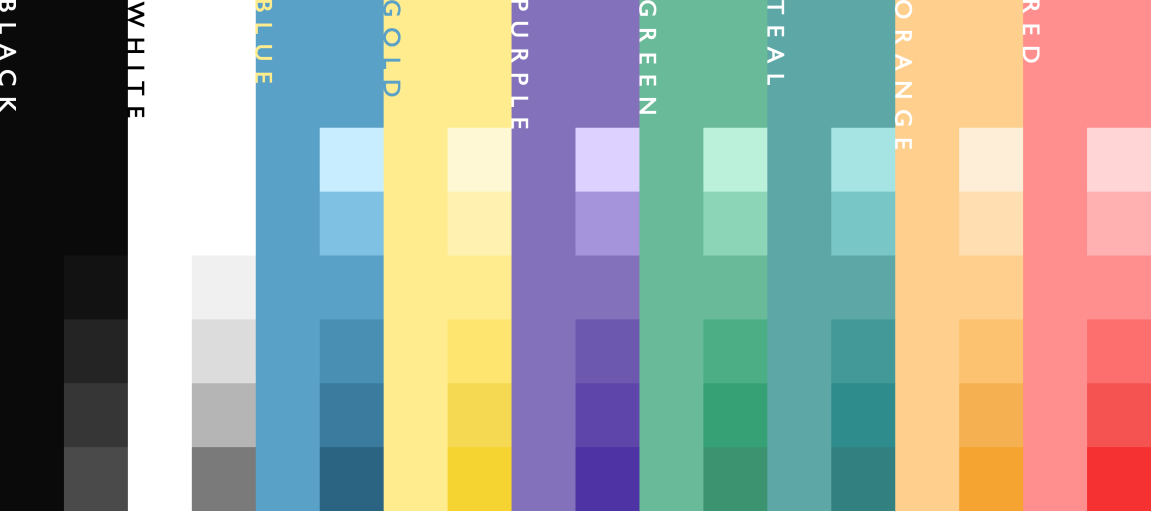
  1. 3.0.1 # Preferred tones of black, white, blue, gold, purple, green, teal, orange, and red are provided, including a primary tone and four alternative tones.
    1. 3.0.1.a # Note: the red colour used in the Skule™ logo’s leaf is not the same as the red provided here (see Appendix B in Chapter 2).
    2. 3.0.1.b # The colours have the following hexadecimal properties (row 1 corresponds to primary tones):
      Black White Blue Gold Purple Green Teal Orange Red
      0a0a0a ffffff 59a1c6 ffec8e 8372bb 68ba98 5da7a7 ffcf8e ff8e8e
      121212 f0f0f0 c8edff fff8d5 dcd1dd bbf1db a6e3e3 ffeed7 ffd5d5
      242424 dcdcdc 7fc1e3 fff2b1 a594dc 8cd6b7 79c6c6 ffdeb1 ffb1b1
      363636 b5b5b5 498fb4 fde56f 6c58ae 4cae85 439898 fdc26f fd6f6f
      4a4a4a 7a7a7a 3b7c9e f5d952 5d45a9 38a87a 319313 f5b151 f55252
      6b6482 f5d431 4d33a3 3b946f 338080 ffa331 f53131
    3. 3.0.1.c # A colour swatch with these colours is shown below (PNG, PSD): color swatch

3.1 # Fonts

  1. 3.1.1 # For a serif font, the Caecilia font should be used. (Download Link)
    1. 3.1.1.a # Alternatively, Centaur is preferred, keeping in line with the official University of Toronto font guidelines. As Centaur is a licensed font, it must be purchased from a font foundry.
    2. 3.1.1.b # An acceptable substitute font for Centaur and Caecilia is Times New Roman, as per the official University of Toronto font guidelines.
  2. 3.1.2 # For a sans serif font, Gill Sans is preferred; it is a default font on most computers.
    1. 3.1.2.a # Alternatively, the Lato font is acceptable. (Google Fonts)

Appendix D - Documents #

4.0 # Mastheads

  1. 4.0.1 # An internal use document masthead has the following properties:
    1. 4.0.1.a # The Engineering Society Crest (see section 1.1)
    2. 4.0.1.b # The Engineering Society Logo Text (see section 1.2)
    3. 4.0.1.c # Author Name (Garamond, 12pt)
    4. 4.0.1.d # Title (Garamond, 12pt)
    5. 4.0.1.e # The date in [DD Month YYYY] or [Month DD YYYY] format (Garamond, 12pt)
    6. 4.0.1.f # A sample masthead for an internal use document is shown below. Internal Use Masthead
  2. 4.0.2 # An external use document masthead has the following properties:
    1. 4.0.2.a # The Engineering Society Crest (see section 1.1)
    2. 4.0.2.b # The Engineering Society Logo Text (see section 1.2)
    3. 4.0.2.c # Author Name (Garamond, 12pt)
    4. 4.0.2.d # Title (Garamond, 12pt)
    5. 4.0.2.e # The date in [DD Month YYYY] or [Month DD YYYY] format (Garamond, 12pt)
    6. 4.0.2.f # Address (Garamond, 12pt)
    7. 4.0.2.g # Telephone number (Garamond, 12pt)
    8. 4.0.2.h # Fax number (Garamond, 12pt)
    9. 4.0.2.i # Email (Garamond, 12pt)
    10. 4.0.2.j # Website (Garamond, 12pt)
    11. 4.0.2.k # A sample masthead for an external use document is shown below. External Use Masthead
  3. 4.0.3 # A governing document masthead has the following properties:
    1. 4.0.3.a # The complete Engineering Society Logo (see section 1.0)
    2. 4.0.3.b # “University of Toronto Engineering Society” (Garamond, 10pt, Bold)
    3. 4.0.3.c # Title of document (Garamond, 12pt, Bold)
    4. 4.0.3.d # Last Revision date in [DD Month YYYY] or [Month DD YYYY] format (Garamond, 10pt)
    5. 4.0.3.e # For a sample masthead, see this document masthead.
  4. 4.0.4 # Note: Garamond is a default font distributed with most computers.

4.1 # Style Guide

  1. 4.1.1 # Document Layout:
    1. 4.1.1.a # In a document with multiple sections (for example, a document with a main body and an appendix), all sections must be separated by a page break.
    2. 4.1.1.b # All sections of the document (with the exception of the main body section) must be titled in bolded capital letters at the beginning of the section. The title should be the same size as the body text, and should be indented.
  2. 4.1.2 # Document Numbering:
    1. 4.1.2.a # In any given section, each subsection should be given a numerical value, starting at 1. It is also appropriate to begin at 0 if the information in the subsection contains information relevant to the rest of the subsections (such as a general subsection).
    2. 4.1.2.b # Subsubsections should be assigned a lowercase letter of the alphabet, starting at a. Subsections within these subsections should be assigned numerical values in Roman numeral form.
    3. 4.1.2.c # Figures referred to in the document are to be numbered as a subsection of whatever subsection they are included in, and are to be assigned a numerical value starting at 1. Figures should be labeled with bolded text centered below the figure.
    4. 4.1.2.d # Appendices are to be given a capital letter of the alphabet (i.e. ISO Basic Latin Alphabet), starting at A.